Explore the paper · 23 sections
Abstract
What can one individual achieve with publicly available frontier AI models and agentic AI systems when authentic human experience remains the authoritative source?
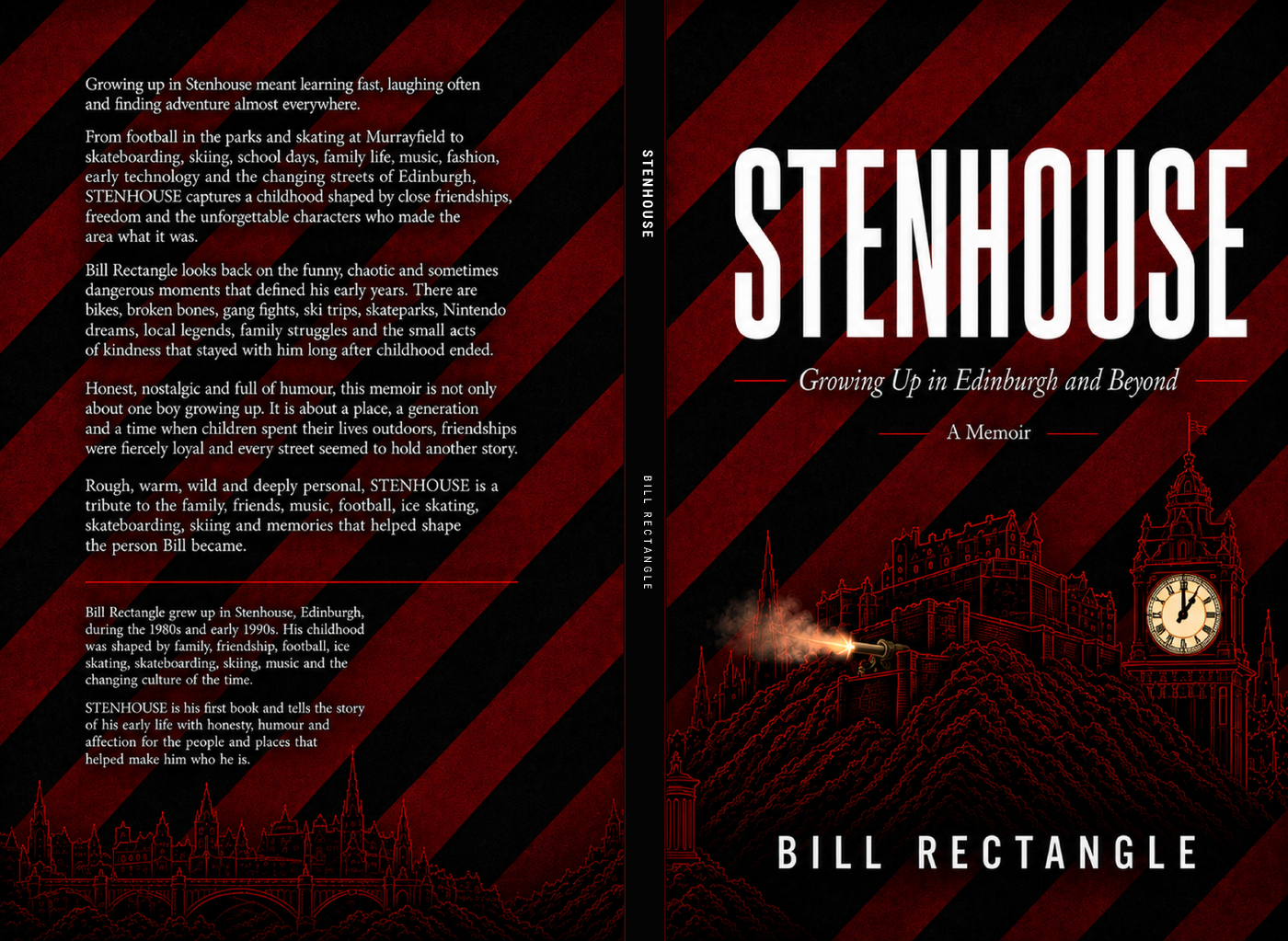
STENHOUSE was conceived from the outset as both a personal memoir and a practical experiment. The source material was my own memory and lived experience of growing up in Stenhouse and Edinburgh during the 1980s and early 1990s. AI assistance was tested across memory exploration, research, organisation, editing, production, platform development and audience engagement. It was never authorised to invent my memories or decide what had happened.
The resulting project includes a paperback, Kindle edition, an author-narrated audiobook lasting more than eight hours, an independent publishing platform and a growing record of external engagement. This paper documents that experience as an observational case study. It is an independent project account, not a controlled comparative model evaluation or a peer-reviewed research paper.
Introduction
A completed book is a visible outcome, but it conceals a considerable amount of work: arranging source material, checking continuity, preparing editions, developing supporting assets and finding readers. STENHOUSE offered a way to explore that entire chain rather than ask only whether AI could help someone write a book.
STENHOUSE: Growing Up in Edinburgh and Beyond is my first independently authored and self-published memoir. Its cultural setting is specific; its practical question has wider relevance to people using contemporary AI to undertake substantial personal projects.
The original STENHOUSE testing concept
The AI experimentation was part of the original STENHOUSE concept. It was not a technological explanation attached to an already completed memoir. A genuine personal narrative provided the source material for exploring, means-testing and benchmarking how far the latest publicly available frontier AI and agentic technology could practically augment the capabilities of one individual.
That choice imposed a clear boundary: the technology could assist with working on the material, but could not become the authority over it. The human remained the author, verifier, controlling mind and final decision-maker. As publicly accessible systems developed, the project extended from language assistance towards tools and increasingly agentic, multi-step workflows.
Human memory as the single source of truth
For this testing methodology, my own memory and lived experience were deliberately treated as the single source of truth. This means authority over the personal narrative, rather than a claim that recollection is infallible or that every historical fact can be established through memory alone.
Conversations with family and friends could check or corroborate recollections. Appropriate public research could verify context, explain a place or clarify the wider period. Those sources supported scrutiny of the memoir; they did not authoritatively replace my account with an AI-generated reconstruction.
AI did not author my memories. I remained responsible for the source material, factual truth, interpretation, ethics, verification and final creative decisions.
Where recollection was uncertain, a plausible model output could not settle the question. A fluent suggestion was something to examine, not evidence that an event occurred. The supplied manuscript also identifies the work as literary memoir, notes privacy changes to some names and identifying details, and explains that dialogue is recreated from memory and family telling. Those conventions should not be confused with a verbatim historical transcript.
Why a real memoir was chosen as the test case
A memoir is a demanding test because authenticity matters as much as presentation. It contains people, feelings, remembered routes and relationships that cannot be checked simply by asking a model for an answer. It also requires the author to judge tone, privacy and the balance between affection, humour and difficult experience.
STENHOUSE recalls family, friendship, community, school days, football, ice skating, skateboarding, skiing, music, fashion, early home computers and technology. Changing Edinburgh neighbourhoods, local characters, small acts of kindness, everyday memories and harder experiences give the account its human texture.
Its setting also captures a generational transition: an analogue childhood moving into the digital era. Cassette culture, early computing, neighbourhood recreation and changing patterns of communication provide a concrete cultural context for an experiment conducted with much newer technology.
From LLMs to modern agentic AI
Large language models remain part of the underlying technology. Agents do not replace LLMs as a category. Publicly accessible systems increasingly combine frontier multimodal models with reasoning, tools, research, files, code execution, web or computer interaction, and multi-step workflows.
An agentic system can use a model as a reasoning engine while adding tools and orchestration to plan and carry out actions. A fixed workflow follows a predefined route; a more agentic implementation allows the model to direct parts of the process and choose tool use. Anthropic makes this architectural distinction in its primary-source discussion of effective agents.[1]
OpenAI’s current reasoning-model guidance describes planning, effective tool use and multi-step agentic workflows.[2] These capabilities help explain the broader workflow explored here; they do not establish that any particular task will complete reliably or that the system understands a remembered life as its author does.
Throughout this paper, the preferred term is publicly available frontier AI models and agentic AI systems. It describes the models together with the systems around them, without implying unrestricted autonomy or claiming access to private research systems.
The benchmark question
How far can one individual take the latest publicly available frontier AI and agentic technology when authentic human source material remains authoritative and the human remains the author, verifier, controlling mind and final decision-maker?
The expanded test was whether assistance could span structured memory exploration, research, organisation, editing and production; help create a finished publishing product; support a functioning independent platform and ecosystem; identify appropriate audiences; and contribute to genuine external readership and engagement.
“Benchmark” is used here in the practical sense of an observed real-world test. The evidence concerns what this project produced and how external people responded. It does not supply a numerical leaderboard of models or an isolated causal estimate of AI’s contribution.
Methodology: what was tested
The work was iterative: human source material and instructions were supplied, assistance was used for bounded tasks, and outputs were reviewed against the source and intended purpose. The project account records the following areas of assistance, where applicable across its development.
| Workflow area | Tasks explored | Human responsibility |
|---|---|---|
| Memory and context | Structured memory exploration, structured questioning, research and contextual verification | Supply recollections; corroborate context; resolve uncertainty |
| Manuscript development | Organisation, continuity checking, language refinement and editing support | Preserve meaning, voice and factual integrity; approve changes |
| Publishing production | Publishing preparation, paperback and Kindle workflows, audiobook-production support | Review editions and production decisions; personally narrate the audiobook |
| Platform and assets | Website development, promotional copy, visual concepts, advertising concepts and scripts, asset management | Choose presentation, assess suitability and approve public material |
| Discovery and planning | Media and outreach research, campaign planning and audience identification | Judge fit, accuracy and relevance; maintain boundaries |
| Engagement | Reader engagement; interaction with media, authors, publishers, book and reader groups, festivals and event organisers | Interpret responses; verify claims; make commitments and final decisions |
| Multi-step operation | Increasingly agentic workflows joining research, files, tools and actions | Define scope, check completion and remain accountable |
This is a description of the tested workflow, not a claim that every activity was fully automated or that every attempted action succeeded.
Human control, verification and boundaries
Human control was substantive. I decided which memories belonged in the book, how people and difficult experiences should be represented, and which proposed edits preserved my meaning. AI output did not remove the need to check names, dates, continuity, claims or links.
Before publication, a small pool of approximately six close family members and friends reviewed the book and supplied feedback. My partner and I also worked through it from beginning to end during a holiday in Gran Canaria, listening to the audiobook for ease of access and discussing it chapter by chapter. These were personal review stages, not independent academic peer review.
Responsibility extended beyond the manuscript. Public statements required evidence, outreach required audience fit, and opportunities required appropriate human judgment. The fact that a system could draft or perform an action did not make that action automatically accurate or appropriate.
From source material to finished book
The manuscript became a completed paperback and Kindle edition, together with an audiobook narrated by me and lasting more than eight hours. Different formats created different production demands: page layout and print presentation, digital reading, and sustained spoken delivery.
Personal narration is a particularly concrete boundary between assistance and authorship. Audiobook-production support could assist the workflow, but the voice, performance and recollected experience remained mine. The completed editions provided tangible outputs against which the original ambition could be assessed.
Building the publishing ecosystem
The outcome extended beyond a manuscript. White Hat Media provided the independent publishing identity and platform. The official STENHOUSE website, promotional films, supporting media and visual material, structured project archives and reusable assets formed the surrounding infrastructure.
Three published formats
Paperback, Kindle and an author-narrated audiobook of more than eight hours.
A functioning platform
Publishing identity, official website, films, visual material, archives and reusable assets.
Real engagement
Interviews, cultural-history features, a podcast appearance, reader reviews and professional responses.
Publishing a finished book represents one benchmark. Building the infrastructure around it, presenting it professionally, finding suitable audiences, maintaining an engagement pipeline and obtaining independent external responses represents a considerably broader test.
The record also includes literary-professional interaction, publisher consideration, author and readership engagement, book and community-group outreach, festival and event opportunities, cultural and social-history interest, and academic consideration. These are different stages of engagement. Consideration or an invitation is not equivalent to acceptance, a contract or a completed event.
Testing audience discovery and engagement
The memoir’s subject matter suggested several relevant audiences: Edinburgh and Scottish communities, social and cultural history, nostalgia and generational memory, memoir readers, early-computing enthusiasts, and directly connected recreation and music communities. The task was to identify genuine connections between the work and an outlet’s audience.
AI assistance could support research and planning, but audience relevance remained a human judgment. Reaching a large number of contacts was not, by itself, evidence of successful engagement. A published interview, a thoughtful reader response or a request to consider the manuscript carried different evidential weight from an outbound message.
The practical test included maintaining information and reusable assets across that pipeline. The result is described through documented outcomes below, rather than unsupported campaign totals, conversion rates or an assertion that all interest was caused by AI.
Evidence of external engagement
The evidence is deliberately separated so that readers can assess what each type supports.
| Evidence type | What it shows | What it does not establish |
|---|---|---|
| Published features and interviews | External editorial interest and public presentation of the project | A universal endorsement of the methodology or measured readership |
| Public customer reviews | Individual reader reactions and a recorded ratings snapshot | A representative sample or that all eight ratings were five stars |
| Professional correspondence | Responses to supplied material, including praise, requests and rejection | Publisher acceptance, a contract or institutional endorsement |
| Academic consideration | A full article submitted for consideration with the book as reference material | Acceptance, publication, peer-review completion or university affiliation |
Public customer reviews: Amazon reader evidence
Public customer reviews · recorded snapshot supplied for this paper
All three visible written reviews in the supplied snapshot awarded STENHOUSE five stars. The overall score includes eight global ratings, so the three written reviews must not be presented as the whole ratings distribution. These are preserved review texts supplied for this paper; the live Amazon review state was not independently reverified during preparation.
Brilliant
Stenhouse is a very interesting read. Grips you from start to finish. Very nostalgic. A must read.
One of the Best Memoirs I’ve Read
I thoroughly enjoyed reading STENHOUSE: Growing Up in Edinburgh and Beyond. It’s an honest, engaging and nostalgic memoir that really brings 1980s and early 1990s Edinburgh to life. The stories are full of humour, warmth and genuine emotion, and the writing makes you feel like you’re experiencing the journey alongside the author. Whether you grew up in Edinburgh or simply enjoy well-written memoirs, I’d highly recommend this book. A fantastic first publication, and I’m already looking forward to the next one.
One person had marked this review as helpful at the captured point.
Phenomenal Nostalgic Read!
Readers of history; specifically the Analog to Digital era will really enjoy this book!
Verified Purchase is recorded only for the review where that status was supplied. No unrecorded verification status has been inferred for the other two.
Professional and editorial responses
These are specifically supplied extracts and summaries of professional or editorial correspondence. They are separate from public customer reviews. Private emails, addresses and additional correspondence metadata are not reproduced.
David Graham
After reading the synopsis and sample chapters, he described STENHOUSE as “an entertaining read” and the writing style as “warm and engaging”. He also said I had done a “thoroughly professional job” in independently publishing the project.
Katharine
The working-class Edinburgh setting and the details of family, football, music, and early technology give the childhood world a clear sense of place.
Jules Wake
Her feedback recognised Stenhouse as more than simply a backdrop, the balance between nostalgia and harder realities, and how music, fashion, early technology and games help place the reader inside the period. This is a paraphrase, not an exact quotation.
Geoff Broadway
I can see it’s beautifully written.
Adeola Adenawo
Thank you for sharing your beautiful story with us. We have enjoyed reading the excerpt and would love to have the full manuscript for further consideration.
The full manuscript was subsequently supplied. The request records further consideration, not acceptance.
Christine Green
There is much to admire here but it’s not, alas, for us. Thank you for thinking of us.
This was a rejection. The appreciative wording is retained together with that decision.
Archives Portal Europe
Preserved feedback included “very interesting” and “in line with the content we would like to promote in our network.” This led to an invitation to contribute an approximately 800-word article about STENHOUSE, personal testimony, memory and its sources. The invitation is distinguished from a published contribution.
Published interviews and features
Six existing public features and interviews provide different perspectives on the memoir and project. Summaries follow the supplied project record; the original platforms retain their own titles, wording and historic URLs.
My Random Musings
An introduction to M. G. Judge / Bill Rectangle: Edinburgh background, IT and technology, learning, hobbies, why STENHOUSE was created and the experience of personally narrating the audiobook.
Read / listen on the original platformBrindle Books
An author-focused interview on Edinburgh memories, the Bill Rectangle pen name, STENHOUSE and how a long professional career in IT eventually led to independently writing and publishing a memoir.
Read / listen on the original platformCultura
A social and cultural-history feature on Edinburgh childhood in the 1980s and early 1990s, exploring community, place, technology and the transition from analogue life into the digital era.
Read / listen on the original platformThe Living Memory Project
A lived-memory and social-history feature on preserving ordinary lives, neighbourhoods, families, communities and everyday experience alongside major events and famous figures.
Read / listen on the original platformThe 90s Rewind Report
An approximately 43-minute audio interview discussing STENHOUSE, adolescence, Edinburgh, memories, music and popular culture around the end of the 1980s and beginning of the 1990s.
Read / listen on the original platformThe Book Hook Online
A substantial interview on Edinburgh and its changes, dancing and breakdancing, music, a 30-plus-year IT career, AI methodology, independent publishing through White Hat Media and possible future projects.
Read / listen on the original platformAcademic consideration: Review of Scottish Culture
Currently under consideration · not accepted or publishedRemembering Stenhouse: Everyday Edinburgh, Embodied Place and the Analogue-to-Digital Generation
An academic article arising from the STENHOUSE project is currently under consideration for the Review of Scottish Culture. Following interest from Dr Valentina Bold, Editor of the journal, a full article was submitted in September 2026. The complete STENHOUSE book was supplied as supporting/reference material.
The article explores everyday Edinburgh social and cultural history, family and neighbourhood life in Stenhouse, childhood routes and remembered places, football and recreation, Hillend skiing, skateboarding and Livingston Skatepark, music and cassette culture, early home computers and technology, community identity, embodied place, lived memory and the analogue-to-digital generation.
The journal’s public site describes its support by the European Ethnological Centre at the University of Edinburgh.[3] That institutional context belongs to the journal. This independent project paper claims no University of Edinburgh affiliation or endorsement. Submission does not establish acceptance, publication or completed peer review.
What the experiment demonstrates
The strongest evidence is the existence of the outputs and the specificity of the responses: a finished memoir in three formats, a working independent publishing platform, supporting assets, public interviews and features, recorded reader reactions and substantive professional engagement.
The case suggests that publicly available frontier AI models and agentic AI systems can support a wider range of tasks within an individual’s project than prose assistance alone. Organisation, production support, research, infrastructure and audience discovery formed part of the same practical undertaking.
My interpretation is that this expanded the scope of a personal project pursued around professional and family responsibilities. The record demonstrates what was achieved in this case; it does not isolate how much of each outcome was attributable to AI rather than my experience, effort, relationships, subject matter or external collaborators.
Limitations
- One project and one author. This is an observational account, without a controlled comparison group, standardised task suite or model-by-model scoring.
- Changing technology. Public systems, tools and access conditions evolved. A result achieved at one point may not reproduce identically later.
- No measured productivity claim. No complete time, cost or intervention ledger is presented. The value of limited personal time is discussed qualitatively.
- Memory has limits. Human recollection is the narrative authority, but can be uncertain. Corroboration and contextual research remain important.
- Selection and sample size. The recorded review sample is small and the quoted professional responses are selected evidence. They do not describe every reader or every outreach outcome.
- Interest is not acceptance. Requests, invitations, opportunities and academic consideration must remain distinct from contracts, completed events and publication.
- Verification has boundaries. Some live links could not be independently fetched during preparation. Public pages and ratings can change after the recorded snapshot.
- Human responsibility persists. Fluent outputs and multi-step actions still require checking. This case does not establish unsupervised reliability.
Conclusions
STENHOUSE began with authentic human memories and a deliberate experiment in assistance. The central principle remained consistent: my lived experience was the single source of truth for the personal narrative, and I retained responsibility for interpretation, verification, ethics and final decisions.
The practical benchmark grew from completing a book to developing the surrounding publishing ecosystem and obtaining genuine external engagement. Its value lies in that connected, real-world scope: a substantial personal project undertaken outside a professional 9–5 and alongside family commitments.
The case supports a careful account of augmented individual capability. AI helped with processes; it did not supply the life being remembered. Future evaluation could strengthen this account through clearer task logs, time and cost records, intervention counts and reproducible checks across changing systems.
Publication, book and media links
Reference links to the published editions, official platform and promotional films.
Disclosure and methodology note
This article is independently published by the author/project, White Hat Media. AI assistance forms part of the project described and supported the preparation and presentation of this paper. It is not an independent audit, a peer-reviewed publication or an institutionally affiliated paper.
Project facts, professional quotations, review transcripts and submission status follow the specifically supplied project evidence. Professional extracts are reproduced only within the names, organisations, dates and quotations authorised for this article. Jules Wake’s feedback is explicitly paraphrased. No private email addresses, message headers or additional correspondence metadata are included.
External/public sources supply the published interviews and features, the journal’s public context and the terminology references below. Interpretations of significance are identified as such. Recorded ratings are a snapshot and should not be read as a claim about an indefinitely current Amazon page.
Terminology and public-context references
- Anthropic, Building effective agents — primary-source distinction between workflows and agents.
- OpenAI, Reasoning models — current guidance on reasoning, tools and multi-step agentic workflows.
- Review of Scottish Culture — public journal and institutional context.
Prepared October 2026. External terminology and public-context sources consulted 4 October 2026. Project outcomes and status are reported as supplied for this edition.